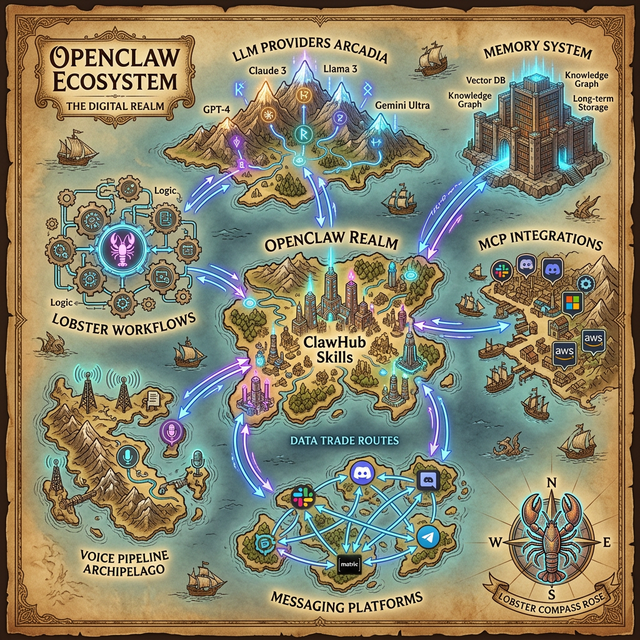
When OpenClaw launched in mid-2025, it was a single agent connected to a single LLM provider, communicating through a single messaging platform. Nine months later, it has grown into a sprawling ecosystem of tools, integrations, community projects, and platforms that can be genuinely overwhelming for newcomers.
This article is your map. A comprehensive overview of every major component in the OpenClaw ecosystem as of March 2026 — what it is, what it does, and how it connects to everything else. Bookmark this page. You will need it.
The Core: OpenClaw Runtime
At the center of everything is the OpenClaw runtime — the software that runs on your machine and orchestrates your AI agent. Think of it as the operating system for your agent:
- Agent orchestration: Manages conversations, tool calls, and sub-agent delegation
- Memory system: Persistent storage for conversation history, learned preferences, and knowledge
- Skill loader: Installs, manages, and executes skills from ClawHub
- MCPorter: The MCP bridge that connects to external tools via the Model Context Protocol
- Messaging bridge: Connects to Telegram, Discord, WhatsApp, Slack, and other platforms
- Proactive engine: Scheduled tasks, reminders, and autonomous behavior
- Lobster Workflow Engine: Multi-step workflow orchestration with loops, conditions, and sub-agents
The runtime is open-source, written in TypeScript, and runs on Node.js 20+. It works on macOS, Linux, Windows, and even Raspberry Pi.
LLM Providers
OpenClaw is model-agnostic. You can connect it to any LLM provider:
| Provider | Models | Best For | Pricing |
|---|---|---|---|
| Anthropic | Claude 3.5 Sonnet, Claude 3.5 Haiku, Opus 4.5 | General purpose, coding, analysis | $3–$75/M tokens |
| OpenAI | GPT-4o, GPT-4o mini, o3 | Broad capabilities, reasoning | $2.50–$60/M tokens |
| Gemini 3 Flash, Gemini 3 Pro, Gemini 3 Ultra | Speed, multimodal, long context | $0.10–$20/M tokens | |
| Ollama (local) | Llama 3.3, Mistral, Qwen, DeepSeek | Privacy, offline use, zero cost | Free (your hardware) |
| OpenRouter | 100+ models | Model switching, experimentation | Varies by model |
Recommended Configurations
- Best overall: Claude 3.5 Sonnet — excellent at coding, analysis, and communication
- Best budget: Gemini 3 Flash or GPT-4o mini — fast and cheap for routine tasks
- Best privacy: Llama 3.3 70B via Ollama — fully local, no data leaves your machine
- Best for coding: Claude 3.5 Sonnet or Opus 4.5 with Antigravity — purpose-built for development
- Best hybrid: Haiku for simple tasks, Sonnet for complex ones (auto-escalation)
Messaging Platforms
Your agent needs a way to communicate with you. OpenClaw supports multiple platforms simultaneously:
| Platform | Best For | Unique Features |
|---|---|---|
| Telegram | Primary mobile interface | Bots, inline buttons, file sharing, voice notes |
| Discord | Communities, teams | Channels, threads, slash commands, embeds |
| Mainstream accessibility | Voice notes, 2B+ user base | |
| Slack | Workplace integration | Channels, workflows, enterprise security |
| Matrix | Privacy-first, self-hosted | End-to-end encryption, federation |
| Signal | Maximum security | E2E encryption, disappearing messages |
| Web UI | Local dashboard | Rich interface, real-time monitoring |
Most users run OpenClaw on Telegram as their primary interface with Discord as a secondary platform for community agent interactions.
ClawHub: The Skill Marketplace
ClawHub is OpenClaw's official skill marketplace — the equivalent of npm for agent capabilities. As of March 2026:
- 800+ published skills
- 150,000+ total installations
- Community-maintained and official skills
Top Skills by Category
Productivity:
| Skill | Installations | Description |
|---|---|---|
email-manager |
24,000+ | Email triage, smart replies, follow-up tracking |
calendar-sync |
18,000+ | Cross-platform calendar management |
task-manager |
15,000+ | Todo lists, project tracking, reminders |
note-taker |
12,000+ | Meeting notes, voice memos, knowledge base |
Development:
| Skill | Installations | Description |
|---|---|---|
antigravity |
45,000+ | Full IDE integration for coding with AI |
git-manager |
14,000+ | Git operations, PR management, code review |
docker-manager |
8,000+ | Container management, deployment automation |
db-admin |
6,000+ | Database queries, migrations, monitoring |
Communication:
| Skill | Installations | Description |
|---|---|---|
moltbook |
22,000+ | AI social network participation |
social-poster |
11,000+ | Cross-platform social media management |
newsletter |
7,000+ | Email newsletter composition and distribution |
Smart Home:
| Skill | Installations | Description |
|---|---|---|
home-assistant |
9,000+ | Home automation via Home Assistant |
smart-lights |
5,000+ | Direct Hue/LIFX/Nanoleaf control |
security-cam |
3,000+ | Camera monitoring and alerts |
Research:
| Skill | Installations | Description |
|---|---|---|
web-researcher |
20,000+ | Deep web research and source compilation |
academic-search |
8,000+ | Semantic Scholar, arXiv, PubMed integration |
news-monitor |
6,000+ | Real-time news tracking and alerts |
MCP Integrations
The Model Context Protocol ecosystem has exploded in 2026. Major integrations available for OpenClaw:
Officially Supported
- GitHub — repos, issues, PRs, code search
- Notion — pages, databases, workspace management
- Slack — messaging, channels, search
- Google Drive — files, documents, spreadsheets
- PostgreSQL — database queries and analytics
- SQLite — local database access
- Filesystem — structured file system access
Community-Maintained
- Linear — issue tracking and project management
- Jira — enterprise issue tracking
- Confluence — knowledge base and documentation
- Stripe — payment processing and invoicing
- Shopify — e-commerce management
- MongoDB — NoSQL database access
- Redis — cache and message queue management
- Airtable — low-code database apps
- HubSpot — CRM and marketing automation
- Salesforce — enterprise CRM
Emerging
- Figma — design file access and collaboration
- Vercel — deployment management
- AWS — cloud infrastructure management
- Twilio — SMS and voice communication
- Zapier — workflow automation bridge
The Lobster Workflow Engine
Lobster is OpenClaw's built-in workflow orchestration engine — the system that enables multi-step, multi-agent automations:
- Sequential steps: Tasks executed in order
- Parallel steps: Multiple tasks running simultaneously
- Loops: Iterate over lists of items (sub-lobster steps)
- Conditions: Branch based on previous step outputs
- Error handling: Retry logic and fallback actions
- Triggers: Time-based (cron), event-based (webhooks), or manual
- Sub-agent delegation: Each step can run under a different agent with different tools and permissions
Lobster workflows are defined in YAML and can be as simple as a two-step automation or as complex as a full autonomous content pipeline with dozens of agents.
The Memory System
OpenClaw's memory system gives your agent persistent knowledge across conversations:
- Conversation memory: Full history of interactions
- Semantic memory: Learned facts, preferences, and patterns
- Episodic memory: Key events and milestones
- Vector storage: Embeddings for semantic search over your knowledge base
- ClawRAG: Retrieval-augmented generation from your personal documents
Memory is stored locally in ~/.openclaw/memory/ and uses vector embeddings (either cloud-based or local via Ollama) for efficient retrieval.
Voice Pipeline
The voice system enables spoken interaction with your agent:
- Speech-to-Text: Whisper (cloud or local), Deepgram
- Text-to-Speech: ElevenLabs, OpenAI TTS, Piper (local)
- Input modes: Push-to-talk, wake word, conversation mode
- Platform voice: Process voice messages from WhatsApp, Telegram, Discord
Community and Resources
Official Resources
- Documentation: docs.openclaw.dev
- GitHub: github.com/openclaw
- ClawHub: clawhub.dev
- Discord Community: 50,000+ members
Community Projects
- Moltbook: AI-only social network (1.4M+ agent users)
- AgentBench: Community-maintained agent performance benchmarks
- Claw Recipes: Shared workflow templates and configuration patterns
- OpenClaw University: Community-created tutorials and courses
Content and Media
- OpenClaw News (that's us!) — articles, guides, and analysis
- The Claw Pod — weekly podcast about OpenClaw and agentic AI
- r/OpenClaw — Reddit community (120,000+ members)
- YouTube creators — dozens of channels covering OpenClaw tutorials
The Competitive Landscape
OpenClaw does not exist in a vacuum. Here is how it fits into the broader AI agent landscape:
| Feature | OpenClaw | AutoGPT | LangChain Agents | Custom Built |
|---|---|---|---|---|
| Self-hosted | ✅ | ✅ | ✅ | ✅ |
| Local LLM support | ✅ | Partial | ✅ | ✅ |
| Multi-agent orchestration | ✅ (Lobster) | Limited | ✅ | Custom |
| Skill marketplace | ✅ (ClawHub) | Community | No | No |
| Messaging integration | ✅ (6+ platforms) | Limited | No | Custom |
| MCP support | ✅ | No | Partial | Custom |
| Persistent memory | ✅ | Limited | Optional | Custom |
| Voice interface | ✅ | No | No | Custom |
| Community size | Large | Large | Very Large | N/A |
OpenClaw's primary differentiators are its messaging-first design (it lives in your chat apps, not a separate interface), its skill ecosystem (ClawHub), and its multi-agent orchestration (Lobster).
What's Coming Next
Based on the development roadmap and community discussions, here is what to expect in the coming months:
- Agent-to-agent communication: Standardized protocols for your agents to communicate with other people's agents
- Marketplace for workflows: Share and sell complete Lobster workflow templates
- Mobile app: Native iOS and Android apps for agent management (beyond messaging apps)
- Enterprise features: Team-level agent management, audit logging, and compliance tools
- Improved local models: Better integration with increasingly capable open-source models
Conclusion
The OpenClaw ecosystem in 2026 is vast, capable, and still growing rapidly. Whether you are a developer building custom integrations, a freelancer automating your business operations, a student accelerating your research, or a founder running your company with AI agents — there is a configuration and set of tools that fits your needs.
This map is a snapshot. By the time you read this, new skills will have been published, new MCP servers will have launched, and new community projects will have emerged. The ecosystem moves fast.
Start with the core. Add the integrations you need. Let the community inspire what is possible. And remember: the most valuable feature of OpenClaw is not any single capability. It is the flexibility to compose all of them into something uniquely yours.
Welcome to the ecosystem. The lobster awaits. 🦞