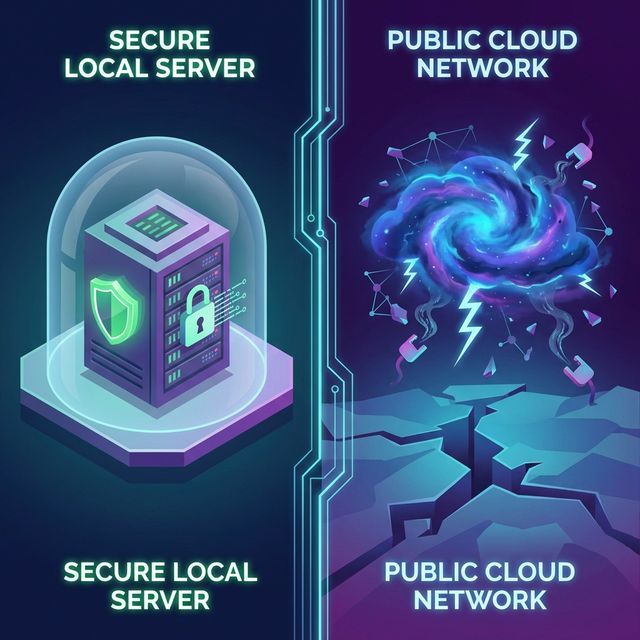
The year 2023 was the year of "WOW." We were collectively stunned by the capabilities of ChatGPT, Claude, and Gemini. The year 2024 became the year of integration, where every app and service rushed to slap an "AI inside" sticker on their product.
But as we settle into this new AI-driven reality, a critical question is emerging for developers and power users alike: Should I rent my intelligence, or should I own it?
OpenClaw was built on the premise that the future of personal AI is local. But is that just philosophical idealism, or does it make practical, economic sense? In this deep dive, we are going to look past the hype and analyze the hard numbers of running OpenClaw locally versus relying on cloud APIs.
Part 1: The Economics of Intelligence
Let's start with the wallet. The common assumption is that cloud AI is cheap (often free, initially) and local AI is expensive (hardware costs). This is true for the casual user, but the math changes drastically for the power user or the always-on automated agent.
The "Token Tax" Calculation
Cloud providers charge by the "token" (roughly 0.75 words). It seems microscopic—fractions of a cent per 1,000 tokens. But an autonomous agent like OpenClaw reads a lot.
Imagine a simple workflow: You want your agent to read 50 unread emails every morning, summarize them, check your calendar, and draft replies to the important ones.
- Input Context: 50 emails x 500 tokens = 25,000 tokens.
- Reasoning/Output: 1,000 tokens of summaries and drafts.
- Daily Total: 26,000 tokens.
- Monthly Total: ~780,000 tokens.
Using a high-end model like GPT-4o (approx. $5.00/1M tokens input, $15.00/1M output), this single workflow costs roughly $5-$8 per month.
That sounds affordable. But that is one workflow. Add in:
- Searching code documentation while you program.
- Summarizing news articles (RSS feeds).
- Chatting with you throughout the day.
- Analyzing your financial spreadsheets.
A truly helpful autonomous agent can easily consume 5 to 10 million tokens per month. At that scale, your API bill is suddenly $50 to $100/month.
The Cost of Local Hardware
Now, compare this to the hardware guide we published recently. A robust setup with a used RTX 3090 (24GB VRAM) costs about $700.
If your cloud API bill would have been $70/month:
- Break-even point: 10 months.
After 10 months, your local "intelligence" is essentially free (minus electricity). And unlike a cloud subscription, hardware is an asset. You can resell that GPU later. You cannot resell your OpenAI API usage history.
Verdict: For sporadic usage, Cloud wins. For an "always-on" continuous agent like OpenClaw, Local wins significantly in the long run.
Part 2: The Privacy Paradox
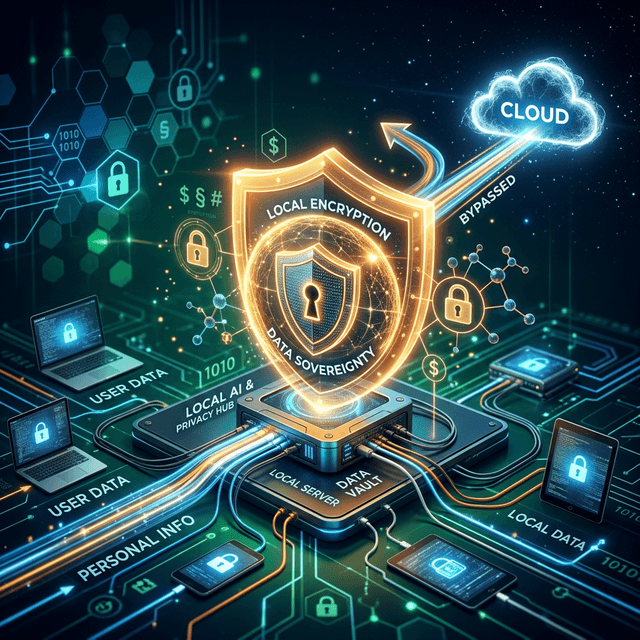
Cost is just math. Privacy is about sovereignty.
When you use a cloud LLM, you are sending your data to a third party. OpenAI, Anthropic, and Google all have stringent data policies, and for enterprise customers, they promise not to train on your data.
But "not training on your data" is not the same as "not seeing your data."
The "Man in the Middle" Risk
To process your request, the text must be decrypted on their servers. This means there is technically always a point where your data is visible to the provider.
For "summarize this recipe," who cares? For "analyze my bank statements to update my budget," do you really want that JSON payload flying across the internet? For "review this proprietary code for bugs," you might be violating your company's NDA by pasting it into a cloud chatbot.
OpenClaw's approach
With OpenClaw running locally:
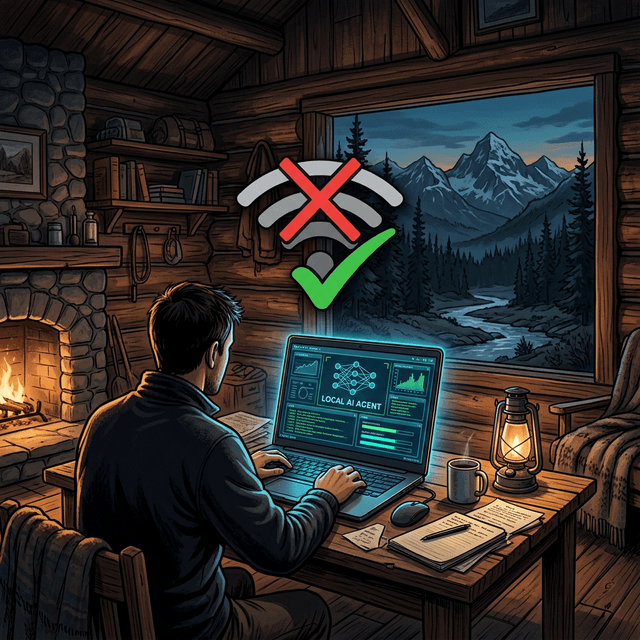
- Air-Gapped Capability: You can literally unplug your ethernet cable, and your agent will still act. It can organize your files, write code, or sort your photos without a single byte leaving your house.
- No Terms of Service: There is no "Trust & Safety" team reading your logs.
- Sanitized Context: If you do choose to use a cloud model for a specific tough problem (e.g., configuring OpenClaw to use GPT-4 only for complex coding tasks), you can sanitise the input. You control exactly what is sent.
Verdict: Local is the only option for true privacy advocates and handling PII (Personally Identifiable Information).
Part 3: Reliability and Sovereignty
The third pillar is control.
The "Lobotomized Model" Problem
Anyone who has used ChatGPT for a long time has noticed "drift." A prompt that worked perfectly in November might stop working in December because the model was updated, "aligned," or optimized for speed.
When you build an automation workflow on top of a cloud API, you are building on shifting sands. The provider can change the model's behavior overnight.
With local AI, you download a model file (e.g., Llama-3-8B-Instruct-v2.gguf). That file never changes. It is frozen in time. If you spend weeks refining a prompt to work perfectly with that specific model, it will work perfectly forever. You, not the vendor, decide when to update.
Uptime is Up to You
Cloud APIs go down. They have outages. They have rate limits that kick in right when you are in the middle of a critical task.
Your local GPU does not have rate limits. It does not go down because a server farm in Virginia lost power. As long as you have electricity, you have intelligence.
Part 4: The Quality Gap (The Elephant in the Room)
We have to be honest: GPT-4 is smarter than your local Llama 3.
This is the main argument for the cloud. The frontier models are order-of-magnitude larger than anything you can run at home. They have broader knowledge bases and better reasoning capabilities for extremely complex, multi-step logic puzzles.
However, the gap is shrinking—fast. Make no mistake, the "small" models of 2024 destroy the massive models of 2022.
The "Good Enough" Threshold
For 90% of daily tasks, you don't need Einstein.
- Do you need GPT-4 to summarize an email? No.
- Do you need GPT-4 to rename a file? No.
- Do you need GPT-4 to tell you the weather? No.
A quantized 8B or 70B parameter model is "smart enough" for the vast majority of automation tasks.
The Hybrid Future
This brings us to the optimal way to use OpenClaw: The Hybrid Model.
OpenClaw allows you to configure different providers for different tasks.
- Default (Local): Use a fast, free local model (like Llama 3 or Mistral) for 95% of tasks: chat, summarization, file application, and browsing.
- Fallback (Cloud): Configure a "Smart" provider (Claude 3.5 Sonnet or GPT-4) for the 5% of tasks that stump the local model.
This gives you the best of both worlds: the privacy and cost-savings of local AI, with the "big gun" backup available for pennies when you really need it.
Conclusion
The cloud is convenient. It's easy. But it's a rental.
Running OpenClaw locally is an investment in your own digital infrastructure. It turns "AI" from a service you subscribe to into a utility you own, like the electricity in your walls or the CPU in your laptop.
As models get smaller and more efficient, and hardware gets cheaper and faster, the case for the cloud gets weaker every day. Sovereignty is the future. And with OpenClaw, that future is already here.